
Last updated August 26, 2026
Free on-site gate assessment - hinges, posts, and your LiftMaster or Nice gate operator checked before anything is quoted
The assessment is free and the quote is the invoice.
 Before
 After
After Before
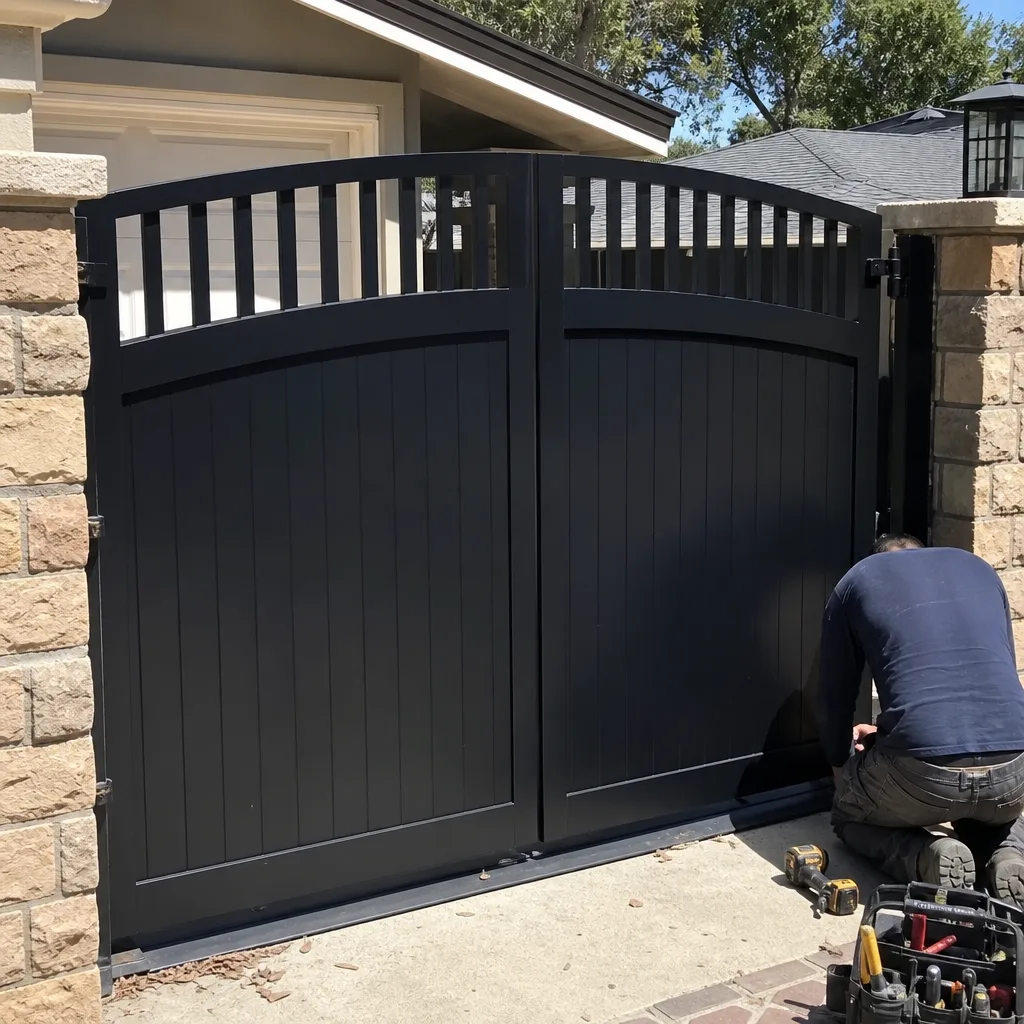 After
After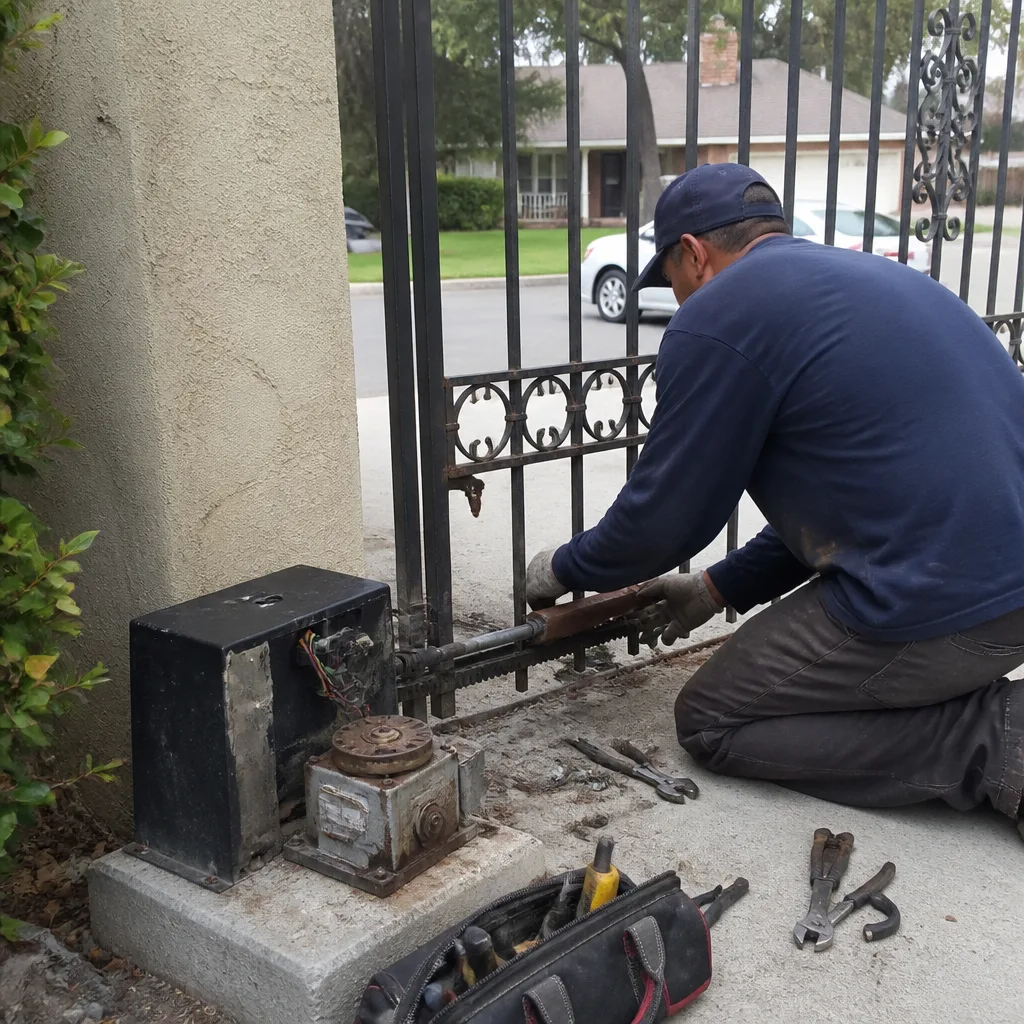 Before
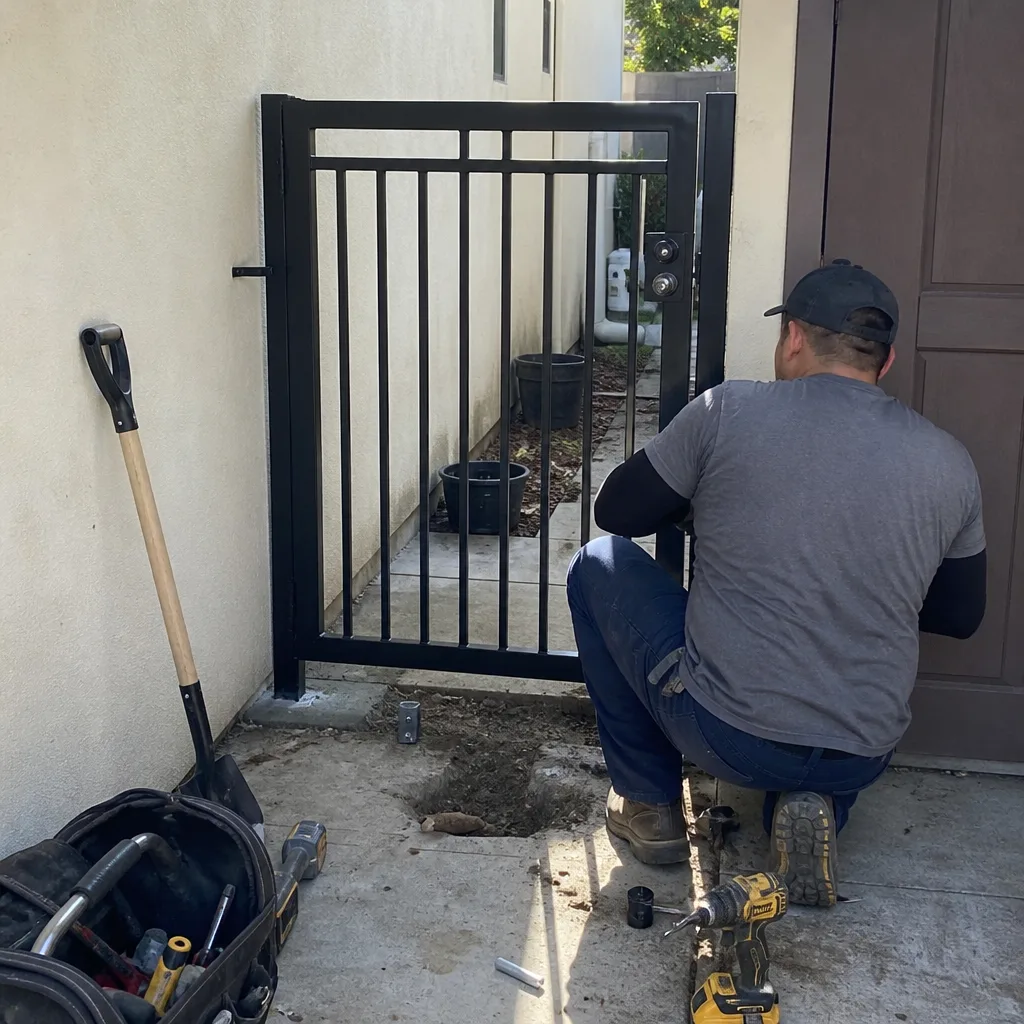 After
AfterDIY vs Professional Gate Repair: The Arcadia Homeowner’s Decision Guide
Every few weeks, someone in Arcadia shows me a gate repair they started themselves and couldn’t finish. The pattern is almost always the same: the job looked simple in a six-minute video, the tools they had were close enough, and the part that went wrong was the one the video skipped. This guide isn’t here to talk you out of doing your own gate work. It’s here to help you sort your repair into one of three honest categories before you unplug anything, loosen anything, or start cutting. If you’re in Arcadia, you probably already know which gates on your street sag, which ones whine, and which ones have been propped open with a cinder block since spring. By the time you finish reading, you’ll know exactly where yours falls.
Quick Answer
Most gate repairs in Arcadia fall into three categories: genuinely safe for a homeowner with basic tools, doable but risky if you lack specific equipment or trade knowledge, and professional-only regardless of how handy you are. The smart approach is to do the diagnostic work yourself, save the money on a service call by knowing what’s wrong before you call, and bring in a professional for anything involving stored energy (torsion springs, counterweights, heavy panels off their hinges) or electronics you haven’t worked with. If we’re talking a gate that won’t close all the way because a hinge is wet and rusted, that’s a Saturday project. If the spring on a 400-pound iron gate is involved, that’s a phone call to someone who has done it since 2001.
Table of Contents
- The Repairs That Are Genuinely DIY-Safe
- The Repairs That Are DIY-Accessible but Risky
- The Hard Line: Professional-Only Repairs
- Torsion Springs and Counterweights: The Physics You Can’t Argue With
- The Tool Threshold: What Tutorials Show vs. What the Job Actually Needs
- What a DIY Attempt Gone Sideways Actually Costs in Arcadia
- The Preliminary Diagnostic: How to Know What’s Wrong Before You Call
- Common Mistakes to Avoid
The Repairs That Are Genuinely DIY-Safe
Some gate work is honest, low-stakes labor. If you own a drill, a level, and a set of wrenches, you can handle more of it than the gate companies in Arcadia will tell you. The key is knowing which repairs sit in this category and which ones only look like they do.
Hinge lubrication is the most obvious one. A gate that squeals in the morning when the Arcadia air is still damp usually just needs the hinge pins cleaned and greased. Use a spray lithium grease, not WD-40. WD-40 is a water displacer, not a long-term lubricant, and it’ll dry out and leave you squealing again in a month. Take the pin out if you can, clean it with a rag, coat it, put it back. Twenty minutes.
Loose hardware is another. Gate bolts back out over time, especially on wooden gates that shrink and swell with Southern California’s dry season. Walking the length of the gate with a socket set and snugging everything down is a legitimate maintenance task. So is replacing rusted screws that have lost their bite. If the screw hole is stripped out, drill it clean and use a slightly larger stainless screw. Arcadia’s dry climate means less rust than coastal cities, but irrigation overspray will rot hardware just fine.
Adjusting a simple chain latch, cleaning out a gate track, replacing a battery in a Mighty Mule or Ghost Controls remote, straightening a bent picket that isn’t load-bearing, and resetting a breaker on an opener are all fair game. These are the repairs where a homeowner saves real money by doing the work themselves, and a good gate company won’t pretend otherwise. For Gate Repair Maintenance Checklist for Arcadia Homeowners and other helpful content, see our blog. Gatewood Fence & Gate has been fixing gates around here since 2001, and we’d rather see you do the small stuff yourself and call us for the repair that actually matters than watch you ignore a hinge problem until the gate drops.
The honest test for this category: if the worst realistic mistake costs you a trip to the hardware store and another hour of work, it’s DIY-safe. If the worst realistic mistake costs you a finger or a new gate post, it isn’t. That line matters more than the tool list.
The Repairs That Are DIY-Accessible but Risky
This is the category that separates people who do good work from people who leave a mess for someone else to fix. These repairs are technically possible for a determined homeowner, but they require a level of precision or experience that videos often compress out. Arcadia has plenty of homes with gates that were installed in the 1980s and 1990s, and on those gates, the repair that looks straightforward is often hiding a second problem underneath.
Replacing a hinge that’s worn through is the classic example. On paper, you unbolt the old one, bolt on the new one, done. In practice, the reason the hinge wore through is often that the gate’s weight isn’t being carried properly. The post has shifted, or the gate was hung a little out of square from the start, and the hinge has been doing the job the post should have been doing. Put a new hinge on the same bad geometry and you’ll be back out there in six months doing it again. Fixing the hinge right means addressing the post and the angle, which means knowing how to set a post in concrete and how to shim a gate so it hangs true.
Replacing a gate opener arm is another one. The physical install isn’t complicated, but the travel limits and force settings need to be adjusted correctly for the gate’s actual weight and swing. Set the force too high and the gate will push through an obstruction instead of stopping. Set it too low on a cold morning and the gate will stall halfway and throw an error. These are the adjustments that make the difference between an opener that lasts fifteen years and one that burns out in three. We’ve replaced openers in Arcadia that were less than two years old because the original install wasn’t dialed in, and the owner had been nursing a marginal setup the whole time.
Splicing low-voltage wire for a keypad or intercom also lives here. The work is easy to start and easy to get wrong. A splice that isn’t waterproofed will corrode inside the jacket and cause an intermittent fault that takes hours to trace later. If you’re going to splice, use heat-shrink butt connectors and a proper crimper, not electrical tape and a pair of pliers.
These are the repairs where someone who’s honest with themselves will do an equipment check and a patience check before starting. If you have both, go ahead. If not, the opener diagnostics and adjustments are better off in the hands of someone who does them weekly.
The Hard Line: Professional-Only Repairs
Some gate work is not a question of skill level. It’s a question of physics, liability, and the kind of failure that doesn’t give you a second chance. The line has nothing to do with how handy you are. Hal Gatewood has been running Gatewood Fence & Gate in Arcadia since 2001, and he’ll tell you the same thing: there are repairs he wouldn’t let an amateur attempt even with supervision.
Here’s the non-negotiable list:
- Torsion spring adjustment or replacement. These springs are wound under enormous tension and release that energy instantly if they slip. This is the repair that puts people in emergency rooms. More below.
- Counterweight or counterbalance work on a heavy sliding gate. The weights and cables on a 600-pound steel gate don’t care how careful you were being.
- Cutting and rewelding a structural gate frame. If the frame has cracked or twisted, the repair requires a welder, appropriate technique for the gauge of steel, and an understanding of where the stress paths actually run. A bad weld on a gate frame looks fine for a while, then fails catastrophically at the worst moment.
- Any repair that requires taking the gate off its hinges entirely. A 200-pound gate off its hinges isn’t a two-person job unless both people know what they’re doing, and if it gets away from you, it’s a crush or laceration hazard.
- Powering a new gate opener from the panel. Running new line for an opener means working inside a breaker box. That’s not a handyman-level task in any jurisdiction, and Arcadia is no exception.
- Adjusting safety edges or photoelectric sensors. These are the safety systems that stop the gate before it crushes a car or a child. Getting them wrong isn’t an inconvenience; it’s a real hazard on a very expensive piece of your property.
These repairs demand a person who has done this specific task enough times to have seen the failure modes. The person who shows up from Gatewood Fence & Gate has the name of the business on the invoice and a published address in Arcadia. When a job involves stored energy or overhead loads, that accountability is the difference between a repair done once and a repair done eight times.
Torsion Springs and Counterweights: The Physics You Can’t Argue With
Torsion springs on a gate do the same job as the ones on your garage door, and they kill the same way. A torsion spring stores energy by winding, and that energy is always trying to get out. When a spring under tension lets go, the metal doesn’t flop to the ground. It unwinds with enough force to break bones or take off fingers. This isn’t a worst-case scenario that requires bad luck; it’s what the spring is designed to do, and it’s what it does when it slips off the winding bars. The reason professionals use specialized winding bars instead of screwdrivers or pry bars is that the bars are the right diameter, the right length, and the right steel to keep control of the spring while it’s being wound.
Counterweights on a sliding gate work on the same principle through a different mechanism. A heavy gate that slides on a track often uses a counterweight and cable system to balance the panel’s mass. The cable is under tension. The weight is suspended. If the cable snaps or the wrong connection is removed, that weight comes down and the gate becomes an uncontrolled mass. You can’t out-grip a falling counterweight any more than you can out-run a spring.
The takeaway for an Arcadia homeowner is simple: if your gate’s problem involves a wound spring or a suspended weight, stop your diagnostic at identifying the problem and make the call. The diagnostic matters because knowing it’s the spring and not the hinge means whoever you call can come prepared. The repair itself is not a task you workshop your way through. We’ve repaired gates around Arcadia where the homeowner had gotten far enough into the spring work to realize they were in over their head and had to carefully back out. The best outcomes we see are when people stop before they start.
The Tool Threshold: What Tutorials Show vs. What the Job Actually Needs
One of the biggest disconnects in DIY gate repair is between the tools you see in a video and the tools the job actually takes. A tutorial will show a clean socket set, a cordless drill, and maybe a level. What it won’t show you is the tool the person filming actually used off-camera to get to the point where the tutorial starts.
Here’s an honest assessment for several common gate repairs in Arcadia:
Hinge replacement on a metal gate: The video shows an impact driver and a socket set. What you really need is a way to support the gate while the hinge is off (a floor jack with a block of wood works, a second person holding it doesn’t), a way to shim it precisely (thin metal shims, not painted stir sticks), and possibly a drill with cobalt bits if the old hinge bolts are rust-seized. If the hinge bolts snap off in the post, you now need bolt extractors and the patience to use them without ruining the threads in the post.
Opener install on a swing gate: The video shows the opener kit and basic hand tools. What you also need is a multimeter to verify the low-voltage wiring, a way to confirm the gate’s swing direction and travel limits before you lock the arm in place, and drill bits rated for the steel or the masonry piers you’re mounting to. A standard bit set from a big-box store will smoke itself against the steel used in many Arcadia gate installations.
Track cleaning and adjustment on a sliding gate: The video shows a brush and a wrench. What your specific sliding gate in Arcadia probably needs is a wire wheel for the rust on the track, a replacement roller wheel that matches the existing one (there are at least four common sizes, and the wrong one binds), and the knowledge to tell whether the track itself has settled out of level. A track that’s settled can’t be cleaned back into working order.
The honest self-assessment is this: if the video’s tool list is what you have and you have to improvise for anything else, the job is already drifting toward the risky category. Tools aren’t snobbery. They’re the difference between torquing a bolt to spec and rounding it off. And if you own none of the specialized gear and expect to do this once, buying it for one repair often costs more than the service call would have.
What a DIY Attempt Gone Sideways Actually Costs in Arcadia
Let’s put real numbers on the repair that didn’t go right, because “you might spend more” is vague enough to ignore. See our Gate Repair Cost Breakdown: The Arcadia Homeowner’s Reference for 2026 for detailed pricing. This is what we’ve seen on gates around Arcadia when a homeowner starts a repair and it goes wrong, then calls someone to undo and redo the work.
A hinge job that started and stopped because the bolts snapped or the post was out of square: the homeowner has already spent $35 to $70 on hinges and hardware they now can’t use. The repair to actually fix the post, rehang the gate, and replace the hinge correctly typically runs $250 to $450 depending on whether the post needs resetting in concrete. The DIY attempt didn’t just fail; it added a trip charge or wasted parts on top of the repair that was needed anyway.
An opener install that got wired backwards or never got properly adjusted: the homeowner spent $400 to $700 on the opener kit. When the gate stalls or the motor burns out early because the settings were never right, the professional has to diagnose the existing mess, make it work or replace the unit, and do it on top of whatever damage the misconfigured setup caused. Total out-of-pocket for the homeowner is often $700 to $1,200 by the time it’s right, when a straight install would have run $450 to $800 including the opener.
And the worst case, which we don’t see often but we do see: someone winding a torsion spring without proper bars loses control. The immediate cost is an emergency room visit. Then the gate still needs the spring replaced correctly, and that job is exactly what the professional charge was going to be in the first place. Nothing about the attempt reduced the bill. It added a medical one on top of it.
This isn’t a scare list. It’s the actual arithmetic. In our experience, the repair that starts as a Saturday project and ends in a Monday phone call costs fifty percent to a hundred percent more than the original repair would have. The difference is rework, and rework is never budgeted.
The Preliminary Diagnostic: How to Know What’s Wrong Before You Call
The smartest move in gate repair, regardless of whether you end up doing it yourself or calling someone, is to arrive at the phone call or the hardware store trip with an accurate description of the problem. In Arcadia, most gate companies charge a trip fee outside their own service area (Gatewood Fence & Gate doesn’t charge a trip charge inside the county), and a homeowner who can describe the actual fault gets better service and a faster fix.
Here’s how to do the diagnostic without touching anything dangerous:
- Identify the gate’s failure mode. Is it sagging on the latch side? Does it not open? Does it open but not close? Does the motor run but the gate doesn’t move? Does it move but not all the way? The answer puts the repair in a specific category before you’ve touched a tool.
- Look at the hardware under weight. With the gate in its normal resting position, examine the hinges. If you can see daylight between the hinge pin and the barrel on one hinge, that hinge is worn. If the gate sags on the latch side, the problem is almost never in the middle of the gate; it’s in the hinge post or the hinge itself. Gatewood Fence & Gate’s rule of thumb: a gate sags in the hinge post, not in the middle, and that is where we start.
- Check what the opener is actually doing. If the opener hums but nothing moves, the capacitor or the motor itself may be failing. If it opens but reverses, the safety sensors or force settings may be at fault. If it works from the wall panel but not the remote, the remote’s programming may have been lost. These are separate problems with separate fixes, and knowing which one you have saves the person you call from bringing the wrong parts.
- Look at the track if it’s a sliding gate. Roll the gate by hand (with the opener in manual mode) and feel for binding. A slide gate that’s hard to push by hand is seldom a motor problem; it’s a roller, track, or alignment problem, and the motor is just the component that’s being asked to work too hard.
- Check for visible damage from outside forces. A cracked weld, a bent post, a panel that’s been hit by a car. Arcadia sees its share of gates clipped by delivery trucks and landscaping crews. This kind of damage is often obvious if you know to look for it, and it changes the repair from an adjustment to a structural fix.
Doing this diagnostic properly costs you nothing and tells you which of the three categories you’re in. If you land in the DIY-safe category, you’ve saved yourself a service call. If you land in the professional category, you’ve saved the person you call a wasted trip, and that often means a faster accurate quote. When you call (626) 628-9548, you get Hal or his crew on the line, not a voicemail, and the conversation is better when the person calling knows the difference between “it’s not working” and “the motor hums but the gate won’t move.”
Common Mistakes to Avoid
- Using the wrong lubricant. WD-40 on gate hinges is the most common mistake we see in Arcadia, and it’s the easiest to avoid. Use white lithium grease or a dedicated garage door/gate grease. WD-40 washes out and the squeak comes back worse.
- Tightening hinges instead of replacing them. A hinge that’s worn through its bushing can’t be tightened back to life. If you’ve already tightened it and the sag persists, the hinge is done. Tightening it further just distorts the leaf.
- Adjusting the opener’s force settings as a workaround for a mechanical problem. If the gate is hard to move, the problem is often a bad roller or a misaligned track. Crank the force up and the opener will push through for a while, then burn out its gears. The opener is trying to tell you something.
- Ignoring the safety edges and sensors because “the gate was always like that.” A gate that reverses or stops unpredictably isn’t quirky; the safety system is acting on an input. Disabling it or adjusting around it creates a real hazard on a gate that weighs more than your car.
- Replacing a gate panel without addressing the post. We see this all over Arcadia: a rotted wooden gate gets swapped for a new one, but the hinge post underneath is still the same failing one. The new gate sags within a year, and the homeowner is frustrated that “the new gate is already bad.” The new gate wasn’t bad. The post it was hung on was never fixed. Fix the panel without the post and you’ll fix it twice.
- Trusting an internet tutorial over the evidence in front of you. Your gate is standing in your driveway in Arcadia. The video was filmed somewhere else, on a gate that may share no dimensions or materials with yours. When the video and the gate disagree, the gate is right.
- Skipping the diagnostic and calling with “it’s broken.” The more specific you can be about what the gate is doing or not doing, the better the quote and the tighter the repair. A homeowner who can say “the opener reverses when it’s eighteen inches from closed” has already figured out half the answer.
When to Call a Professional
Call someone when the repair involves a torsion spring, a counterweight, a gate that has to come off its hinges, any cutting or welding, any new wiring from the panel, or any safety system adjustment. These are the lines where the downside stops being money and starts being injury or property. If your gate is sagging because the hinge post has failed, you’re also in professional territory, because resetting a post means concrete work and the kind of shimming that only makes sense after you’ve hung fifty gates. If you’re unsure which category you’re in, the diagnostic checklist above will tell you. Gatewood Fence & Gate offers free estimates in Arcadia and will tell you honestly if the repair is one you can handle. Call (626) 628-9548 and someone picks up.
Frequently Asked Questions
You can do your own gate work if the repair is in the mechanical maintenance category: hinge lubrication, tightening hardware, replacing batteries in remotes, cleaning tracks, and simple latch adjustments. If the problem involves a torsion spring, a counterweight, a heavy panel off its hinges, or any welding, the repair is not a skill test; it’s a safety decision, and in Arcadia that work is best left to someone who does it daily. Most of the DIY-friendly work is on the surface. Most of the professional work is under load.
The torsion spring, without question. It’s the component that stores enough energy to break bones or remove fingers, and it’s the component that looks deceptively calm when the gate is at rest. If your gate’s spring or counterbalance cable is the problem, stop the diagnostic at identifying it and call a licensed gate repair company. This isn’t about your capability; it’s about what the component can do in a fraction of a second.
A straightforward hinge replacement in Arcadia typically runs $150 to $350 depending on the gate’s weight and whether the post needs work. An opener install ranges from $450 to $800 with the opener. Structural repairs like a cracked frame or a failed post are priced by the repair after the person sees it, and that’s why Gatewood Fence & Gate offers free estimates and no trip charge inside the county. The price is always quoted and agreed before the work starts, no surprises when the invoice comes.
For the DIY-safe category, you need a socket set in metric and SAE, a drill with a proper bit set, a level, a floor jack or similar support, and the right grease. For anything beyond that, the tool list grows fast, and the tools become specialized: winding bars for springs, a welder for steel repairs, a multimeter for electrical diagnostics. If the job needs tools you’d only ever use once, the math usually favors calling someone who already owns them.
Put the opener in manual mode and move the gate by hand. If it’s smooth and easy, the mechanical parts are fine and the problem is likely the opener or its settings. If the gate is hard to push, stiff, or binding, the opener was probably working harder than it should have been, and the fix is mechanical first. This one test saves a lot of wasted parts.
Yes. Gatewood Fence & Gate services Viking, DoorKing, Ghost Controls, Elite, and the rest of the nine major brands we’re certified on, including LiftMaster and FAAC. If it’s an opener we didn’t install, we can still service it. The diagnostics are the same, and the fix often is too. Call (626) 628-9548 with the brand and model in front of you, and you’ll get a straight answer about what’s likely wrong before anyone rolls a truck.
The Bottom Line
Gate repair is not a single activity. It’s a spectrum that runs from hinge grease to spring tension, and the smart homeowner is the one who knows which end of the spectrum they’re looking at before they pick up a wrench. Do the diagnostic work. Be honest about the tools you own and the experience you have. Never touch stored energy, structural steel, or safety systems unless you do it for a living. And if the job lands in the professional category, call someone whose name is on the work. Gate installation in Arcadia and gate repair both come down to the same thing: the post, the hinge, and the load. In our experience, the gates that fail are rarely the ones that were obviously neglected. They’re the ones where a small problem was patched instead of fixed, until the day the patch stopped holding.
Written by Hal Gatewood, Owner at Gatewood Fence & Gate, serving Arcadia since 2001. Explore more guides & resources on our blog.